
New Humanity NGO presents the M.E.D.I.T.erraNEW project at UNESCO
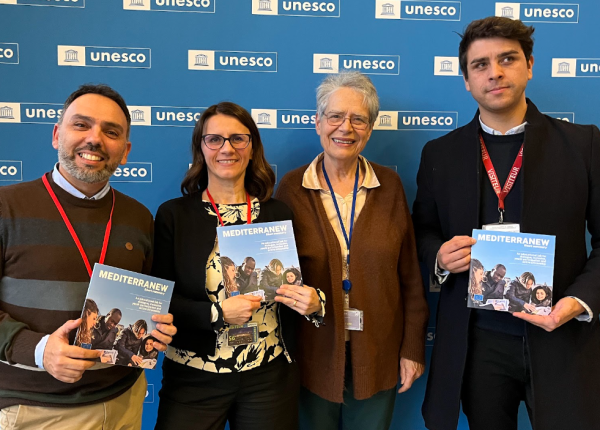
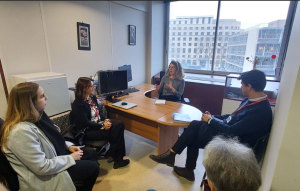
New Humanity NGO presented the M.E.D.I.T.erraNEW project — co-financed by the Erasmus Plus Program — to the Youth Section of UNESCO in Paris. The delegation included Ana Clara Giovani, Juan Camilo Poveda, and Chantal Grevin from New Humanity NGO; Simona Geli from the Centro Internazionale Studenti Giorgio La Pira; and Fabio Mazzeo from the Fundación Igino Giordani. During a one-hour meeting with Aurélie Derigaud-Choquette, the team shared the project’s outcomes, received feedback, and explored possibilities for future collaboration.
M.E.D.I.T.erraNEW is an international initiative dedicated to non-formal education and to strengthening inclusion, intercultural dialogue, and active citizenship among young people, especially those with a migrant background. In a region as diverse and historically connected as the Mediterranean, the project seeks to introduce new educational approaches capable of promoting coexistence, pluralism, and mutual respect — values that directly resonate with UNESCO’s mission.
Throughout its implementation, the project generated four main results:
- A shared educational model
→ Reached 3,000 people through its framework and approach. - An active community of practice
→ 600 educators and managers trained
→ 54 educators directly involved through job shadowing exchanges - Strengthened organizational competences
→ 9 organizations across 6 countries collaboratively engaged and reinforced - A multilingual practical toolkit
→ Expected to be accessed by more than 500 people.
The heart of the project is a multidisciplinary toolkit for educators working in multicultural environments. Developed collaboratively by the partner organizations, it brings together pedagogical modules, training materials, best practices, and practical instruments to support youth empowerment, leadership, and active participation. The toolkit reflects the partners’ shared commitment to offering concrete, experience-based resources that help youth workers navigate and strengthen intercultural learning.
This outcome was shaped through a gradual process of mutual learning. The partners mapped each other’s educational practices, shared experiences during job-shadowing meetings, and received transversal training to align approaches. Together they assessed how methods could be adapted and replicated in different contexts, tested them through local field experimentation, and evaluated their generativity and long-term impact. This iterative journey is what allowed the toolkit to emerge as a grounded, coherent, and truly collaborative resource.
The final presentation at UNESCO reaffirmed the commitment to promoting collaboration between civil society organizations and international institutions. It also highlighted opportunities for continued cooperation and the long-term development of a Mediterranean network dedicated to inclusive education. While the project formally concludes, it leaves behind a community that believes in young people as key actors in building an educational ecosystem capable of transforming relationships and contexts.
This project was implemented by Centro Internazionale Studenti Giorgio La Pira (Italy); Azione Famiglie Nuove – AFN (Italy); Gen Rosso (Italy); Fonds Focolari Actions Solidarité – FFAS (France); Fundación Igino Giordani – FIG (Spain); Udruga za ekonomiju zajedništva – UEZ (Croatia); Humanité Nouvelle (Lebanon); United World for Social Services (Egypt); and New Humanity International (Global, based in Rome).