


Pope Leo XIV at UNESCO: “For if all of us are firmly committed to the grandeur of our common humanity, peace can finally flourish.”
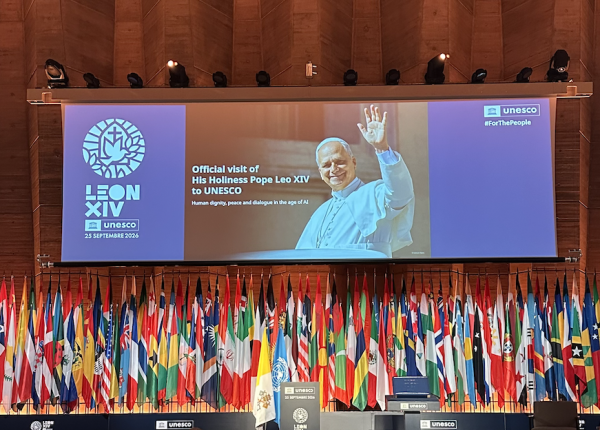
On September 25, Pope Leo XIV made an official visit to UNESCO.
His presence at UNESCO marked the first official visit by a Pope in over 40 years. Invited by the Director General Khaled El-Enany, Pope Leo XIV’s visit included a tour of the UNESCO headquarters, a private audience with the Director General, and the chance to water an olive tree as a pledge of the efforts needed to help peace grow. The culmination of his visit was a highly-anticipated address in UNESCO’s main auditorium on human dignity, peace, dialogue, and AI.
His visit comes specifically after the publication of “Magnifica Humanitas”, his first Encyclical Letter as Pope on the theme of safeguarding the human person in the age of artificial intelligence.
Pope Leo’s visit was anything but routine. Ana Clara, New Humanity Additional Representative in Paris who was present at UNESCO that day, shares: “As soon as one entered the UNESCO premises [that day], one could sense the diversity of the crowd that had gathered to hear Leo XIV. Among the delegations from various countries and representatives of diverse religious traditions were also members of [UNESCO’s] staff, who greeted the Pope as he walked through the hallways with visible joy.” Chantal Grevin, New Humanity representative in Paris, who was invited to the auditorium by the Holy See because of her commitment to interfaith dialogue, echoed this sentiment: “I sensed that people were eagerly awaiting [his visit] and were not indifferent to it. Many of the people who work [at UNESCO] came down from their offices to see the Pope.” When the Pope entered the main auditorium to give his address, he was greeted by a 90-second standing ovation.
During his speech, the Pontiff noted that the path to peace is rooted in dialogue, justice and in the very essence of what it means to be human. He continually called for a remembrance of our shared humanity, as well as for advancements, education, and official processes that honor the dignity of every human life. The Pope asserted, “For if all of us are firmly committed to the grandeur of our common humanity, peace can finally flourish.”
Towards the end of his discourse, he acknowledged that religious traditions serve to give voice to the most profound questions of existence. Pope Leo XIV declared, “As we cooperate in this work, religious traditions have a culturally necessary and irreplaceable role to play. Religions voice our questions regarding the origin of life and its purpose. They deal with the ultimate meaning of our lives, which is reflected in our daily decisions.”
This acknowledgement was particularly significant for New Humanity. New Humanity representatives in Paris, have worked tirelessly with other faith-based NGOs part of the Interfaith Working Group at UNESCO to re-introduce interreligious dialogue into UNESCO’s official programme. After 3 years of efforts, the group succeeded in getting the Italian delegation to propose reintroducing the term “interreligious dialogue” into the organization’s 2026–2029 program (document 43 C/5). The amendment was adopted by the Executive Board with the support of 15 countries and was approved by the General Conference.
Summarizing her impressions of the day, Chantal Grevin shared, “I was truly struck by the deep anticipation surrounding the Pope’s remarks. (…) He brought a spiritual dimension to the discussion, and that is something the world needs today.”
For New Humanity, Pope Leo XIV’s visit to UNESCO is an advancement in the promotion of peace, dialogue, and human dignity at the international level. His presence at UNESCO further encourages the NGO to engage in and promote intercultural and interreligious dialogue in various UN spaces.
Written in collaboration with Ana Clara Giovani